
Loading…
17 June 2026
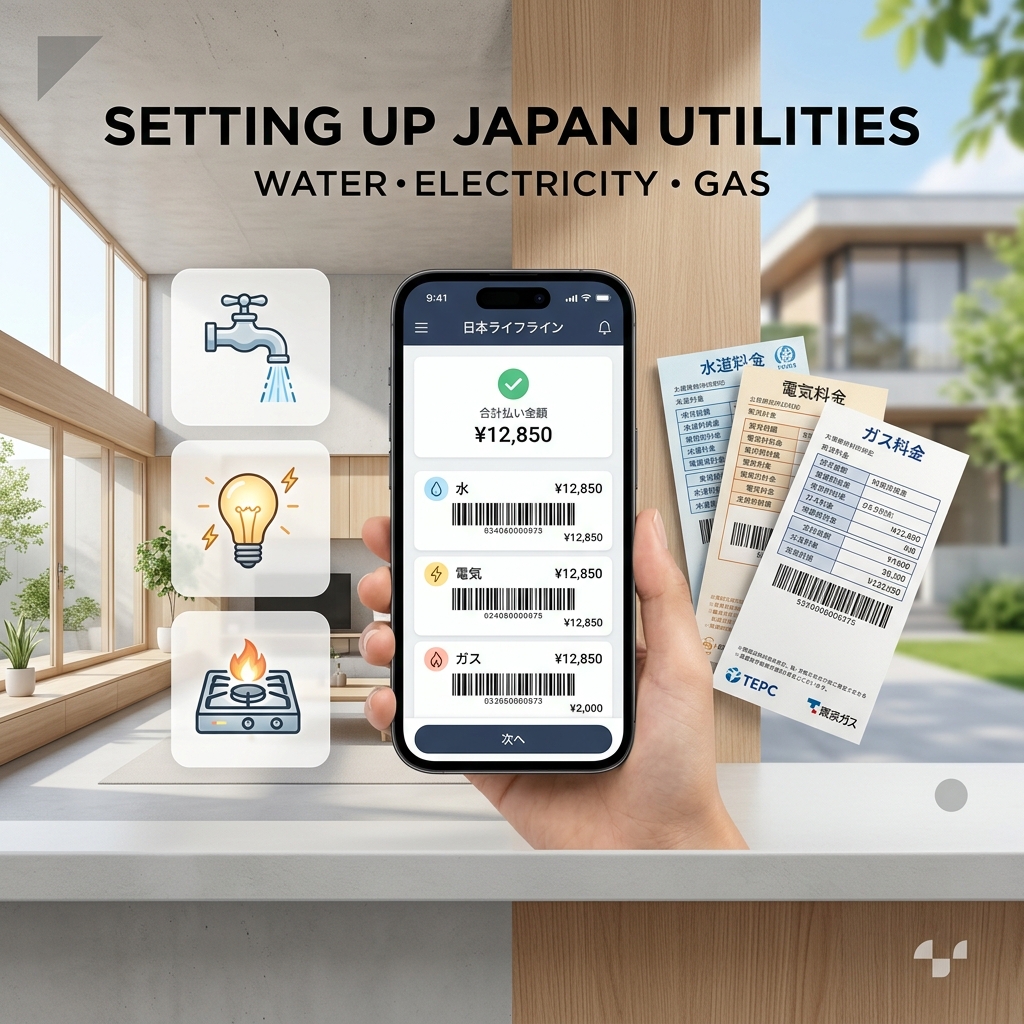
Moving into a new apartment in Japan is a major milestone, but it also comes with the immediate task of activating your utilities: electricity, gas, and water. Unlike some countries where landlords manage utility setups, in Japan, tenants are generally responsible for contacting provider companies directly to open accounts. The process can be completed online or by phone, but understanding the terminology and requirements is key. Here is your step-by-step guide to opening and paying for utilities in Japan.
You can choose from several payment methods to settle your monthly bills in Japan. Compare them below:
| Payment Method | How it Works | Pros | Cons |
|---|---|---|---|
| Convenience Store Slip (Pay-slip) | Paper bills (barcoded) are mailed monthly; pay at cash registers | No bank account needed; pay in cash; simple control | Easy to forget; must physically visit store; no autopay |
| Bank Account Transfer (Direct Debit) | Funds are automatically deducted from your Japanese bank account | Never miss a payment; some providers offer small discounts (e.g. 55 JPY/month) | Requires setting up paper forms; takes 1 - 2 months to activate |
| Credit Card | Charged monthly to a registered domestic or international card | Earn points; automatic billing; easy to track online | Requires entering credit card details; foreign cards are sometimes rejected |
Electricity in Japan is deregulated, meaning you can choose your provider. The default major providers are regional monopolies, such as TEPCO (Tokyo Electric Power Company) in the Kanto region. You can easily register online in English or Japanese a few days before your move-in date.
To open an account or contact your regional provider, visit the official site of TEPCO (Tokyo Electric Power Company).
Gas setup requires more preparation than electricity or water. In Japan, domestic gas is either City Gas (Toshi Gasu) or LP Gas (Propane). You must contact your local provider, like Tokyo Gas, to schedule an activation date.
Important Warning: Unlike electricity and water, which can be turned on remotely, you must schedule an in-person appointment (Kaihi) for gas. A gas inspector must enter your apartment to perform safety checks, test appliances (like your stove and water heater), and turn the valve on. You or a representative must be physically present during this visit.
To schedule your gas inspection or check service details, consult the official Tokyo Gas website.
Water utility services are managed by local municipal waterworks bureaus. In Tokyo, this is the Tokyo Metropolitan Waterworks Bureau. You can register online or mail a paper application form that is usually left hanging on the kitchen faucet or front door handle when you move in.
To register your water service, check the official website of the Tokyo Metropolitan Waterworks Bureau.
Utility bills fluctuate by season—air conditioning in the hot summer and heating in the freezing winter can double your electricity bills. Make sure you budget for these variations. Use the interactive yuzu.help Budget Calculator to estimate typical monthly utility bills. You can also use the yuzu.help Neighborhood Map to locate your nearest ward office, bank branch, and convenience stores where you can pay your bills.
Q: What is the average monthly cost of utilities for a single person in Japan?
The average total cost of electricity, gas, and water for a single resident ranges from 10,000 to 15,000 JPY per month, depending heavily on air conditioner usage.
Q: Do I need a Japanese phone number to set up my utilities?
While a Japanese phone number is preferred, you can register online using your email address, and use a school or employer's contact number if you do not have a SIM card yet.
Q: How far in advance should I contact utility companies before moving in?
It is recommended to contact utility companies 7 to 10 days before your move-in date to ensure services (especially gas inspection appointments) are ready on day one.
Q: What is the difference between City Gas and LP Gas in Japan?
City Gas (Toshi Gasu) is supplied via underground pipes and is generally cheaper. LP Gas (Propane) is supplied via gas cylinders placed outside the building and is more expensive.
Q: Are there English customer service phone lines for utility companies?
Yes, major providers like TEPCO and Tokyo Gas have dedicated English telephone hotlines to help foreign residents open accounts and report issues.
Q: Can I pay my utility bills using a foreign credit card?
Many utility companies accept Visa, Mastercard, and JCB cards. However, some foreign-issued credit cards may fail security checks, so convenience store payments are a safer backup.
Q: What should I do with utility bills when I move out of my apartment?
You must contact each utility company at least one week before moving out to close your accounts and schedule a final reading. You can pay the final pro-rated bill in cash on the spot or online.
Q: Why is the electrical voltage different between Eastern and Western Japan?
Eastern Japan (Tokyo) uses a 50Hz frequency, while Western Japan (Osaka/Kyoto) uses 60Hz. Most modern appliances work in both, but older clocks or microwaves may fail.